
One of the most common things I’ve heard in coaching sessions is, “I lost a client.” Beneath that statement sits a heavy assumption: that something was taken from us—something we owned, something we were supposed to keep. When we frame endings as “loss,” we add unnecessary fear, judgment, and regret to what is usually a normal transition.
This dynamic isn’t limited to business. Throughout life, we interact with people who come and go—clients, vendors, colleagues, fellow volunteers, parents from our kids’ activities, health‑care providers, and countless others. These relationships matter, but most of them are not permanent.
What if we viewed these relationships as rentals rather than possessions? I’m not saying this as a clever metaphor, but as a clear‑eyed way of understanding how human connection usually works.
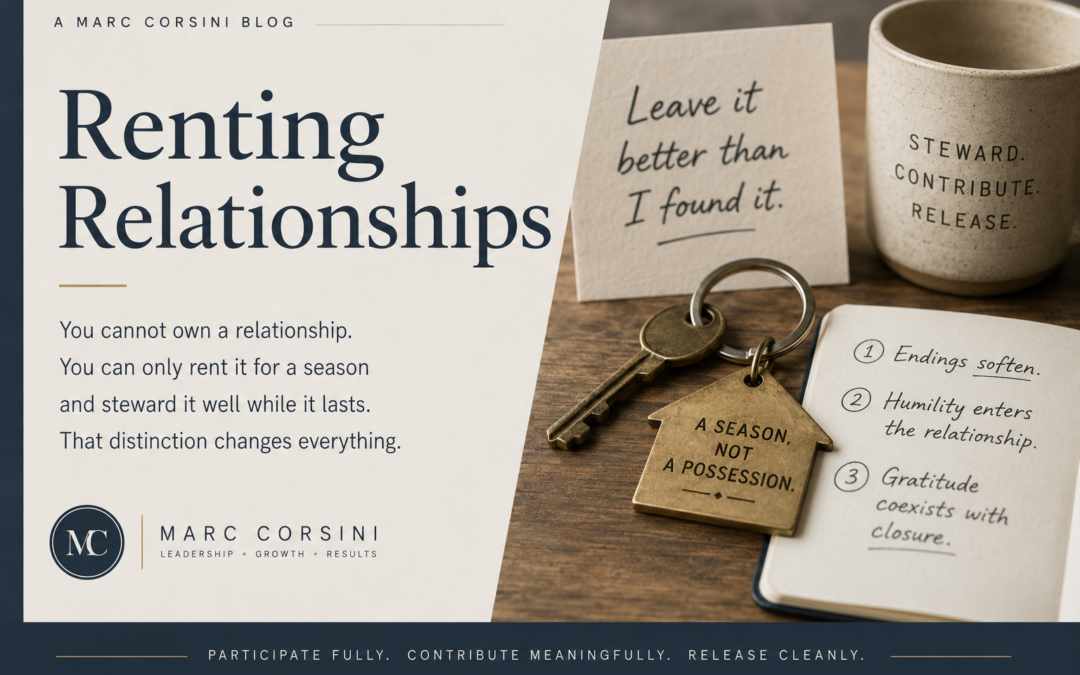
You cannot own a relationship. You can only rent it for a season and steward it well while it lasts. That distinction changes everything.
Think about renting an apartment. When you move out, you don’t say, “I lost my apartment.” You say, “I lived there for a while. It served me well. And then it was time to move.” No drama. No story of failure. No loss either.
But when we believe we own relationships, our behavior shifts. We grip tighter. We avoid hard conversations. We tolerate misalignment. We lead defensively, afraid of losing something we think belongs to us.
When we understand that most relationships are rented, fear diminishes. Decisions become clearer. Endings feel less personal. We show up as stewards—participating thoughtfully, contributing fully, and releasing cleanly when the season ends.
Leaders who embrace this mentality build stronger organizations. They assume change. They invest in depth, systems, and diversified revenue rather than depending upon any single relationship to last forever. Healthy organizations aren’t built on permanence—they’re built on preparedness.
The same principle applies outside the office.
A friend of mine who does a lot of civic and volunteer work has a simple mantra: “Leave it better than I found it.” She knows her season will end—kids grow up, appointments expire, life shifts. She participates fully, contributes meaningfully, and moves on without regret. Nothing lost. Much gained.
Seeing relationships as rentals may sound cold, but it’s actually kinder—to ourselves and to others. If every ending feels like a loss, leadership becomes heavy and reactive. If we accept that relationships have seasons, our work becomes steady, intentional, and grounded.
When we adopt this mindset, three things happen:
1. Endings soften. A client leaving or a season ending may still bring disappointment, but we don’t add shame or fear. We can simply say, “We worked together for a season. It mattered. And now the season has changed.”
2. Humility enters the relationship. If I don’t believe I own the relationship, I’m less likely to manipulate, over function, or perform to keep it alive. I can show up as myself, do good work, and let the relationship be what it is.
3. Gratitude coexists with closure. I don’t have to demonize someone to let them go. I don’t have to rewrite history. I can say, “I’m grateful for what we shared. I learned something. And I’m okay with the ending.”
As I’ve gotten older, I’ve realized that many relationships I thought I “lost” were simply completed. They served their purpose. They ran their course. They ended without needing a villain.
Seeing relationships as rentals doesn’t make us detached. It makes us realistic, softer, and more gracious. It frees us from fear and allows us to participate fully—without clinging, without performing, and without regret when the season ends.