
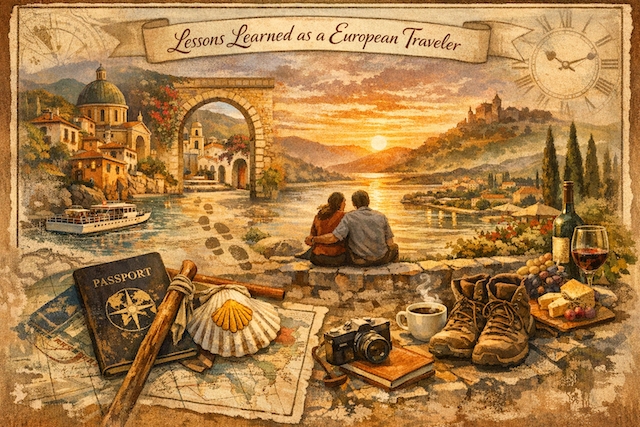
Last year I wrote about lessons I learned while hiking the Camino in Spain. Since then, I’ve added a few more stamps to the passport—and more importantly, a few more layers of perspective on life.
What I didn’t realize at the time is that these trips were also marking a transition—from a life built around effort, achievement, and endurance to one centered on presence, listening, and enoughness.
I am not an expert traveler. But I am a quick study. Over the past two years I’ve been fortunate to spend time in Italy with my family, hike portions of the Camino twice (including a three-week hike and vacation with Matthew, my middle son, after he graduated from college), do a 10-day walking tour in southern Spain, travel through Andalusia, and take a Danube River cruise with my family. Each trip has continued to teach me—often gently, sometimes quite physically—that travel is not just about where you go, but how you go.
I’m still learning! But here are a few lessons I’d like to share from my most recent season of travel:
- Follow your body’s cues along with your itinerary. European travel has forced me to pay attention to what my body tolerates and what it doesn’t. Different ingredients, preparation, portions, and meal timing all matter. Time on your feet adds up! Back home, I could push through discomfort. I found that on the road, your stomach, energy, legs, and sleep (or lack of it) tell the truth of the situation—often quite quickly.
Travel simply removed my usual ability to override those signals. What surprised me was realizing how often I ignore them at home.
- Listen sooner and adjust faster. Less food, more walking, fewer problems. There’s practical wisdom embedded in European daily life. People eat less, linger over meals, and consume intentionally. They also walk a lot more than most Americans. The result is better health, lower costs, and fewer mistakes.
3. Being beats doing—especially on vacation. I used to plan every moment. Andalusia region challenged that mindset with built-in downtime. At first, it was uncomfortable. Eventually it became restorative. Rest is not the absence of productivity—it’s the restoration of presence.
4. Slower travel exposes inner sounds. When life slows, what’s inside gets louder. Travel didn’t create anxiety for me; it revealed where it hides most often. Stillness invites calm. Stillness also invites honesty.
5. You don’t have to extract everything from a place. You can’t consume a destination. You receive what it offers. Presence creates depth of experience and priceless memories, not accumulation.
6. Not everything needs to be optimized. In Europe, I stopped trying to fix small inconveniences—slow service, imperfect directions, minor discomforts. At first, it felt inefficient. Eventually it felt human. The constant urge to optimize is exhausting. Letting things be—even briefly—creates space for joy to show up on its own.
Closing Thought
I have learned that I don’t need to do more to make a trip meaningful. I need to stop performing and start receiving. Travel didn’t ask me to become someone new—it asked me to listen: to my body, my pace, and the quiet signals I often override in the day-to-day back home. When I’m present, a place gives what it gives, and I’m learning to trust that it’s enough.
That lesson didn’t stay in Europe. It came home with me.